How to Optimize Your Shopify Store for GEO (Generative Engine Optimization) in 2026
For nearly twenty years, ecommerce optimization meant one thing:
Rank higher in Google.
Today, that isn't enough.
Millions of shoppers now ask ChatGPT, Claude, Gemini, Perplexity, and AI shopping assistants what products to buy — before ever visiting Google. These AI systems don't simply rank websites. They generate recommendations based on the information they understand, trust, and can access.
That shift has created an entirely new discipline called Generative Engine Optimization (GEO).
If your Shopify store isn't optimized for AI-generated search results, you're already missing opportunities to reach customers who may never perform a traditional Google search.
This guide explains exactly how to optimize your Shopify store for GEO in 2026.
What Is GEO?
Generative Engine Optimization (GEO) is the practice of making your store's content understandable, trustworthy, and accessible to AI systems that generate product recommendations and answers.
Here's how different platforms deliver results:
| Platform | How It Works |
|---|---|
| Google Search | Returns a list of links |
| ChatGPT | Generates a conversation with recommendations |
| Claude | Provides detailed recommendations with reasoning |
| Perplexity | Delivers answers with source citations |
| Shopping Agents | Makes autonomous product recommendations |
Traditional SEO vs GEO
| Traditional SEO | GEO |
|---|---|
| Optimizes rankings | Optimizes AI understanding |
| Keywords | Context |
| Backlinks | Authority |
| SERP | AI responses |
| Meta Tags | Structured Data |
| Crawling | Machine-readable knowledge |
The key difference: SEO helps you rank in a list. GEO helps AI understand and recommend your products. For a complete breakdown of how these approaches compare, see our guide on SEO vs AEO vs GEO.
Why GEO Matters for Shopify Stores
AI shopping assistants are rapidly becoming the primary way consumers discover products:
- ChatGPT Shopping — now recommends products directly in conversations
- Claude — provides detailed product comparisons and recommendations
- Gemini — integrated with Google Shopping for AI-powered discovery
- Perplexity — delivers cited product recommendations with source links
- Amazon Rufus — AI shopping assistant within the Amazon ecosystem
- Future Shopify AI agents — autonomous agents that browse and purchase
When a customer asks "What's the best wall-mounted wine rack for a small apartment?", these AI systems evaluate your entire store — not just your product title. They assess your content depth, structured data, authority, reviews, and technical accessibility.
If your store isn't optimized for these systems, you're invisible to a growing segment of shoppers. Understanding how AI shopping agents discover products is essential context for GEO implementation.
The AI Search Ecosystem
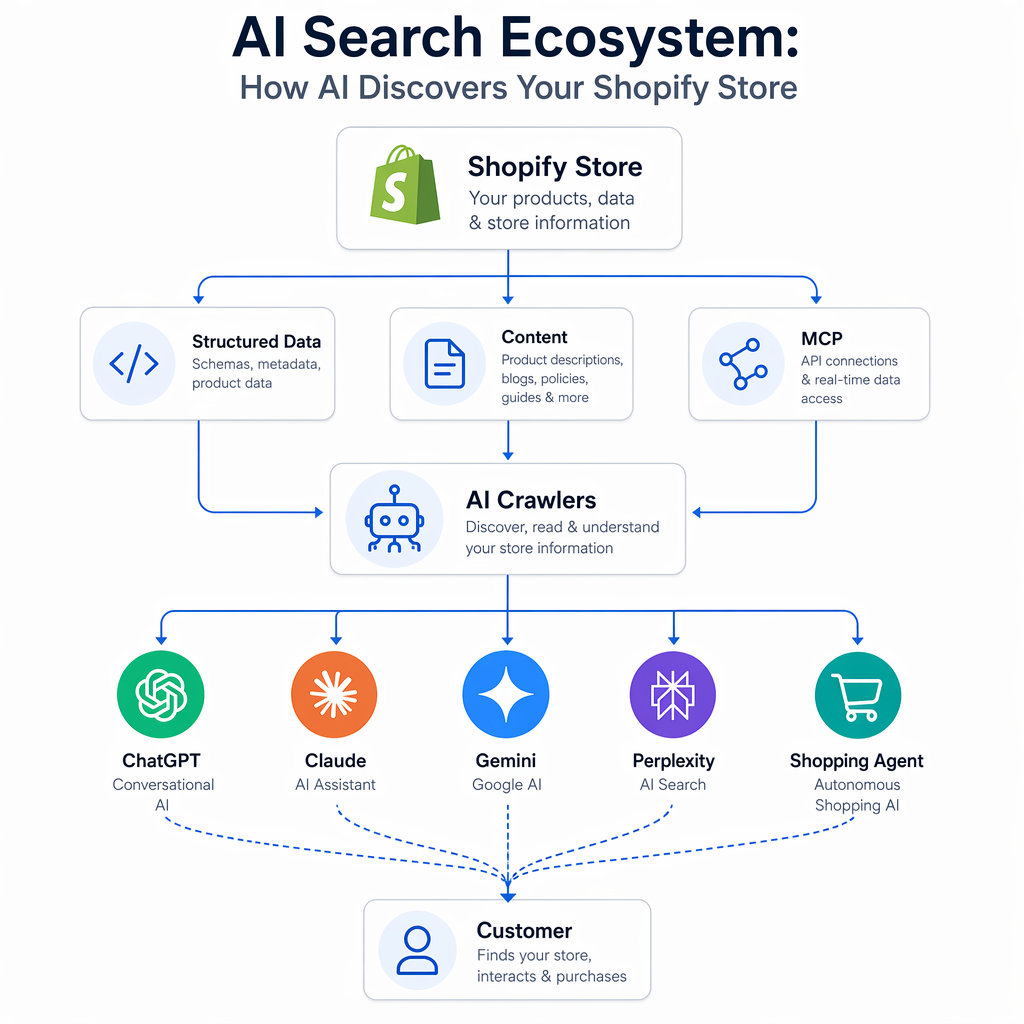
Your Shopify store connects to AI systems through three primary channels:
- Structured Data — Machine-readable schema that tells AI exactly what your pages contain
- Content — Educational, helpful content that demonstrates expertise and answers questions
- MCP (Model Context Protocol) — Direct API connections that let AI agents interact with your store
These three channels feed AI crawlers, which then power recommendations across ChatGPT, Claude, Gemini, Perplexity, and autonomous shopping agents — ultimately reaching customers.
10 Steps to Optimize Your Shopify Store for GEO
1. Create Product Pages AI Can Understand
The biggest GEO mistake is writing product pages for humans only. AI needs structured, comprehensive information.
Instead of:
Wine Rack
Use:
72 Bottle Wall Mounted Metal Wine Rack for Modern Homes
Every product page should clearly explain:
| Element | What to Include |
|---|---|
| Benefits | Why customers choose this product |
| Use cases | Specific scenarios and applications |
| Materials | Exact materials, finishes, and quality details |
| Dimensions | Complete measurements with units |
| Installation | Requirements, difficulty level, tools needed |
| Compatibility | What it works with, room types, bottle sizes |
| Questions | 5-10 FAQs specific to this product |
The more complete your product information, the more confidently AI can recommend it.
2. Add Structured Data Everywhere
Structured data is the language AI uses to understand your pages. Without it, AI systems have to guess what your content means.
Essential schema types for Shopify GEO:
| Schema Type | Where to Use | What It Tells AI |
|---|---|---|
| Product | Product pages | Price, availability, specs, ratings |
| Organization | Sitewide | Business identity, credentials, contact |
| Breadcrumb | All pages | Site hierarchy and navigation structure |
| Article | Blog posts | Content type, author, publish date |
| FAQ | Products & articles | Question-answer pairs for direct extraction |
| Review | Product pages | Customer feedback and social proof |
| Offer | Product pages | Pricing, discounts, shipping details |
| Video | Product & blog pages | Video content for rich results |
Always validate your schema using Google's Rich Results Test and Schema Markup Validator. Invalid schema is worse than no schema — it can confuse AI systems.
3. Build Topic Authority
AI systems strongly prefer stores that demonstrate deep expertise in their niche. Instead of only having product pages, create a comprehensive knowledge center.
Content types that build authority:
- Buying guides — "How to Choose the Right Wine Rack for Your Space"
- Comparisons — "Wall-Mounted vs Floor Wine Racks: Complete Guide"
- Installation guides — "How to Install a Wine Rack in Drywall"
- FAQs — "Wine Storage Temperature Guide"
- Knowledge center — "Everything You Need to Know About Wine Storage"
Each piece of content should link to relevant products and other articles, creating a topical cluster that signals expertise to AI. This is exactly how the SEO to GEO shift rewards depth over breadth.
4. Answer Customer Questions Directly
AI systems love Q&A content because it maps perfectly to how users interact with them.
Examples of questions to answer on your product pages:
- "Can this rack hold Champagne bottles?"
- "Can it mount into drywall?"
- "What's the installation difficulty?"
- "How much weight can it support?"
- "Does it come with mounting hardware?"
Add FAQ sections to every product page, collection page, and blog post. Mark them up with FAQ schema so AI can extract answers directly.
5. Improve Internal Linking
Strong internal linking helps AI understand the relationships between your content and navigate your store's knowledge structure.
Ideal linking hierarchy:
Homepage
  ↓
Category / Collection
  ↓
Buying Guide
  ↓
Comparison Article
  ↓
Product Page
  ↓
Installation Guide
Every page should link to related pages. Every article should connect to relevant products. Every product should link to helpful guides. This creates the topical web that AI uses to assess authority.
6. Publish Original Images and Media
AI systems increasingly evaluate visual content. Original, high-quality imagery signals authenticity and investment.
Types of images that strengthen GEO:
| Image Type | Why It Matters |
|---|---|
| Lifestyle photos | Shows products in real-world context |
| Installation photos | Demonstrates practical use |
| Comparison images | Visual differentiation between options |
| Diagrams | Technical specifications made visual |
| Videos | Installation walkthroughs, product demos |
Always use descriptive alt text that explains what the image shows — this is how AI "sees" your images.
7. Add Trust Signals
AI systems evaluate credibility before making recommendations. The more trust signals your store displays, the more likely AI will recommend you.
Essential trust signals:
- ⭐ Authentic customer reviews (with Review schema)
- 📅 Years in business
- 🏆 Awards and certifications
- 🏭 Manufacturing details and sourcing
- 📋 Clear policies (returns, shipping, warranty)
- 📞 Phone number and contact information
- 👥 Team page with real people
These signals tell AI: "This is a legitimate, trustworthy business worth recommending."
8. Keep Information Current
Outdated information erodes AI trust over time. AI systems check for consistency and freshness.
Keep these updated:
- Pricing (accurate to the penny)
- Availability (real-time stock status)
- Shipping times and costs
- Return policies
- FAQs (add new questions as they arise)
- Blog content (update annually at minimum)
A store with accurate, current information is far more likely to be recommended than one with stale data.
9. Optimize Collection Pages
Most Shopify stores treat collection pages as simple product grids. For GEO, they should be rich content pages.
Each collection page should include:
| Element | Details |
|---|---|
| Introduction | 500-1000 words of helpful buying advice |
| Buying guidance | Who each product is best for |
| Applications | Specific use cases and scenarios |
| FAQ section | 5-10 questions about the category |
| Internal links | To related guides, comparisons, and articles |
| Comparison table | Key differences between products in the collection |
This transforms collection pages from simple listings into authoritative category resources that AI can cite.
10. Make Your Store Technically Crawlable
If AI can't access your content, it can't recommend you. Technical accessibility is the foundation of GEO.
Technical requirements:
- ✅ Fast page load times (under 3 seconds)
- ✅ No broken links (404 errors)
- ✅ Complete XML sitemap
- ✅ Properly configured robots.txt
- ✅ Valid schema markup on all pages
- ✅ Canonical tags preventing duplicate content
- ✅ Descriptive image alt text on all images
- ✅ Mobile-responsive design
- ✅ Clean URL structure
The GEO Optimization Pyramid
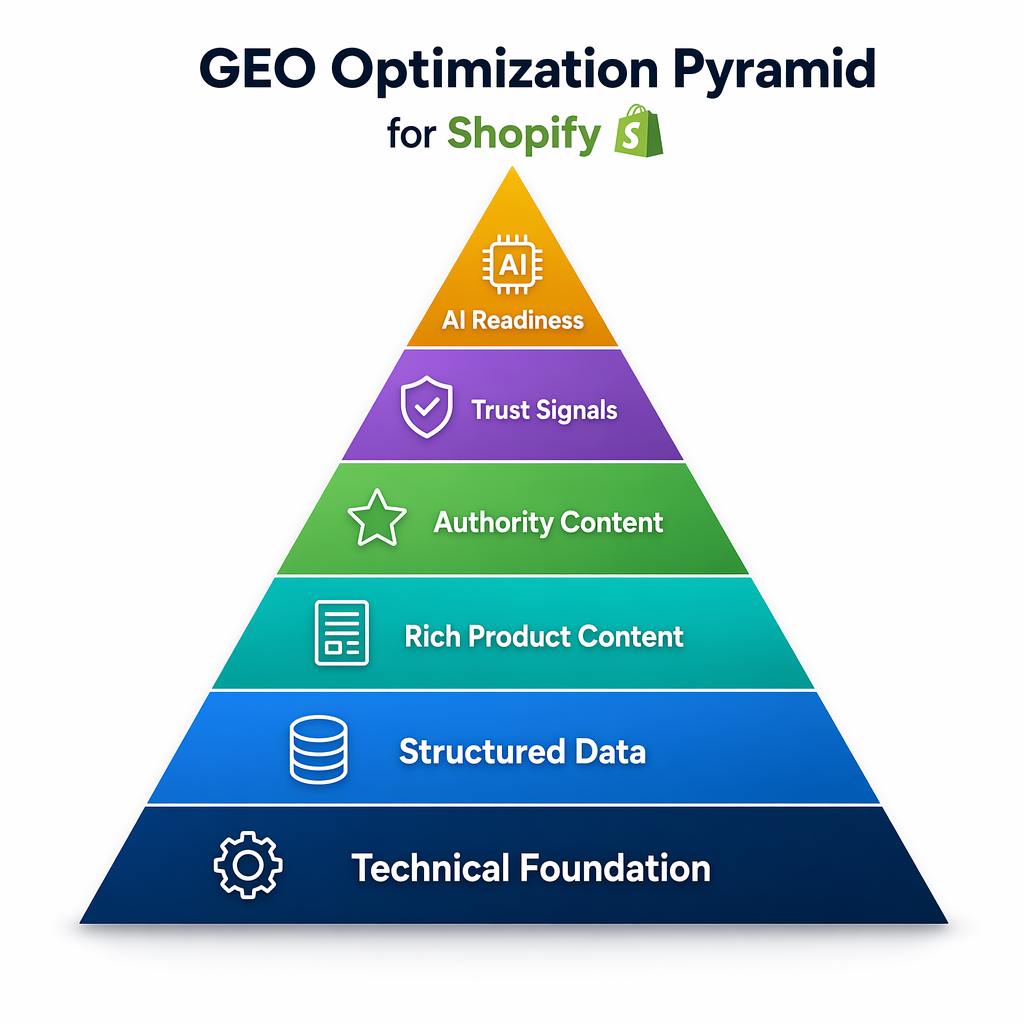
GEO optimization works in layers, each building on the one below:
| Layer | Focus | Examples |
|---|---|---|
| 6. AI Readiness (top) | MCP, APIs, automation | Shopify MCP, shopping APIs, agent access |
| 5. Trust Signals | Credibility indicators | Reviews, awards, policies, team page |
| 4. Authority Content | Expertise demonstration | Buying guides, comparisons, knowledge center |
| 3. Rich Product Content | Comprehensive information | Detailed descriptions, specs, FAQs, use cases |
| 2. Structured Data | Machine-readable markup | Product, FAQ, Review, Organization schema |
| 1. Technical Foundation (base) | Accessibility | Site speed, crawlability, sitemaps, canonicals |
Start from the bottom and work up. Without a solid technical foundation, the layers above won't reach their full potential.
GEO Optimization Checklist
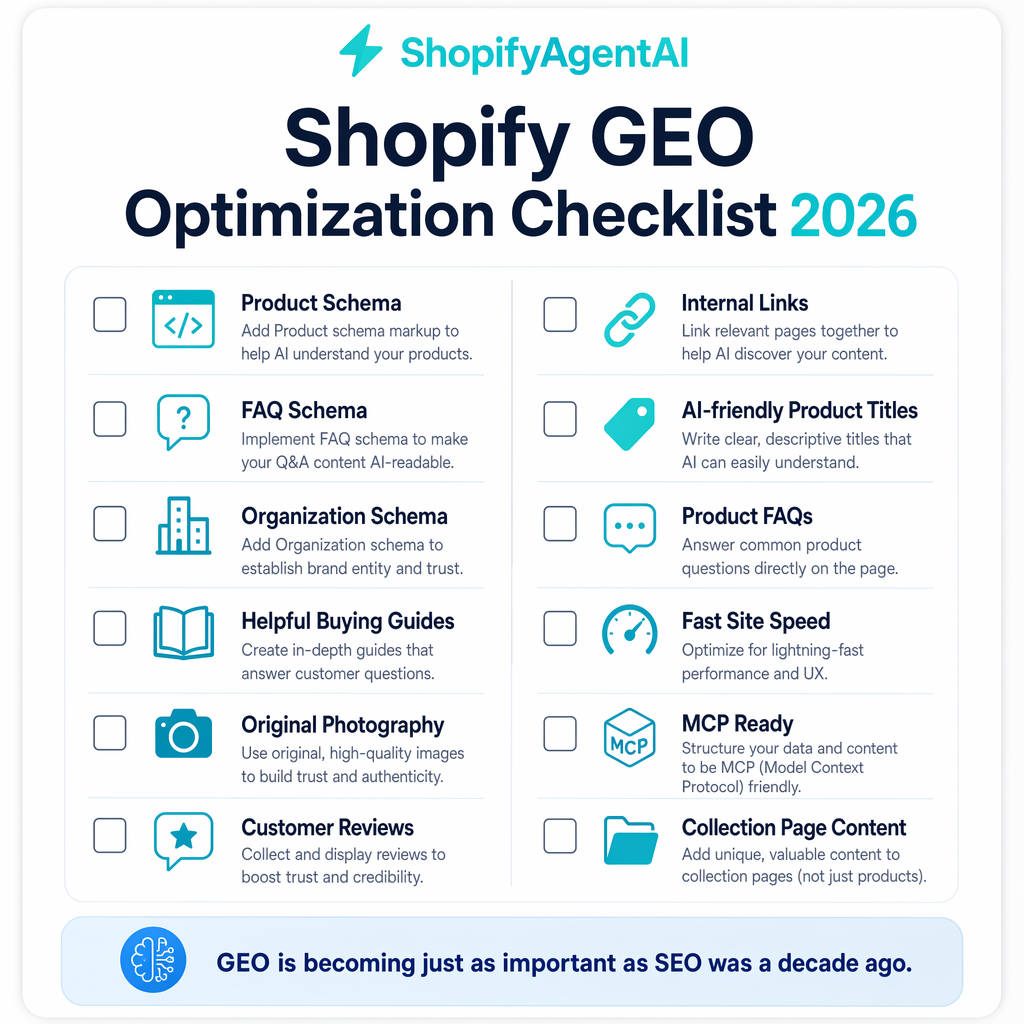
Use this checklist to assess your store's GEO readiness:
| Task | Status |
|---|---|
| Product Schema implemented | ☐ |
| FAQ Schema on product pages | ☐ |
| Organization Schema sitewide | ☐ |
| Helpful buying guides published | ☐ |
| Original photography on all products | ☐ |
| Authentic customer reviews | ☐ |
| Strong internal linking structure | ☐ |
| AI-friendly product titles (descriptive, specific) | ☐ |
| Product FAQs on every page | ☐ |
| Fast site speed (under 3s) | ☐ |
| MCP Ready (Shopify MCP installed) | ☐ |
| Collection pages with 500+ words | ☐ |
If you're checking fewer than 8 boxes, your store has significant GEO optimization opportunities.
Common GEO Mistakes
Many Shopify stores make these errors that reduce AI visibility:
| Mistake | Why It Hurts GEO |
|---|---|
| ❌ Thin product pages | AI can't extract enough information to recommend |
| ❌ Duplicate manufacturer descriptions | No unique value — AI sees the same content everywhere |
| ❌ Missing schema markup | Forces AI to guess what your pages mean |
| ❌ AI-generated content spam | Low-quality content signals untrustworthiness |
| ❌ Broken internal links | Disrupts topical authority and crawlability |
| ❌ No authority content | No expertise signals for AI to evaluate |
| ❌ Missing FAQs | Misses direct question-answer extraction opportunities |
| ❌ Generic product titles | "Wine Rack" vs "72 Bottle Wall Mounted Metal Wine Rack" |
Fixing these mistakes is often the fastest path to improved AI visibility.
The Future of GEO
The GEO landscape is evolving rapidly. Here's what's coming:
Autonomous Shopping Agents
AI agents that can browse, compare, and purchase products on behalf of consumers. These agents will evaluate stores based on structured data, trust signals, and MCP accessibility.
Direct AI-Store Integration
Through protocols like Shopify MCP, AI assistants will interact directly with store systems — checking inventory, comparing prices, and processing orders without human intervention.
Machine-Readable Commerce
The future store isn't just a website — it's a machine-readable knowledge base that AI systems can query, understand, and transact with. Stores optimized for GEO today are building the foundation for this future.
Shopping APIs and Agent Protocols
New standards are emerging that allow AI agents to discover and interact with stores programmatically. Shopify MCP connectors are the first wave of this transformation.
Merchants who invest in GEO now will have a significant head start as these technologies mature.
Where Shopify MCP Fits Into GEO
Shopify MCP (Model Context Protocol) represents the highest level of GEO optimization — making your store directly accessible to AI agents.
| GEO Layer | What It Does |
|---|---|
| Content & Schema | Helps AI understand your store passively |
| Shopify MCP | Lets AI interact with your store actively |
While content optimization helps AI recommend your products in conversations, MCP enables AI agents to:
- Check real-time inventory and pricing
- Access complete product catalogs
- Process orders and transactions
- Provide personalized recommendations based on live data
Combined, content-level GEO and MCP create the most comprehensive AI visibility strategy available to Shopify merchants.
For implementation details, see:
Frequently Asked Questions
What is GEO for Shopify?
GEO (Generative Engine Optimization) is the practice of optimizing your Shopify store so AI systems like ChatGPT, Claude, Gemini, and Perplexity can understand, trust, and recommend your products. It goes beyond traditional SEO by focusing on machine-readable content, structured data, and AI accessibility.
Is GEO replacing SEO?
No. GEO builds on top of SEO. You still need strong technical SEO, quality content, and good site structure. GEO adds the layer of making that content optimized specifically for AI understanding and recommendation.
How long does GEO take to show results?
Most merchants see initial improvements in AI visibility within 2-4 months of implementing comprehensive structured data and content optimization. Full topical authority typically takes 6-12 months to establish. MCP integration can provide faster results for direct AI agent interactions.
Do I need Shopify MCP for GEO?
Not strictly — you can improve AI visibility significantly through content and structured data alone. However, Shopify MCP represents the highest tier of GEO optimization, enabling direct AI-store interaction that passive optimization can't achieve.
What's the difference between GEO and AEO?
AEO (Answer Engine Optimization) focuses on making your content answerable by AI. GEO is broader — it encompasses AEO but also includes structured data, technical optimization, and direct AI integration through protocols like MCP. See our complete comparison.
Can ChatGPT recommend my Shopify products?
Yes. ChatGPT can recommend products from stores that have strong structured data, comprehensive product information, authority content, and trust signals. The more optimized your store is for GEO, the more likely AI systems will include your products in recommendations.
What structured data does Shopify need for GEO?
At minimum: Product, Organization, FAQ, Review, Breadcrumb, and Article schema. For maximum GEO impact, also implement Offer, Video, and AggregateRating schema. Always validate your markup using Google's Rich Results Test.
How do I know if AI is recommending my store?
Regularly test by asking ChatGPT, Claude, Gemini, and Perplexity questions your customers would ask. Monitor referral traffic from AI platforms in your analytics. Track brand mentions across AI responses over time.
Final Thoughts
GEO is becoming just as important as SEO was a decade ago.
Optimizing for AI search involves more than adding keywords — it requires structured data, semantic content, technical optimization, and AI-ready product information working together.
The Shopify merchants who invest in GEO today will be the ones AI systems recommend tomorrow. As autonomous shopping agents become more prevalent and AI-powered discovery replaces traditional search for more consumers, the gap between GEO-optimized stores and everyone else will only widen.
Start with the fundamentals: comprehensive product pages, structured data, authority content, and strong internal linking. Then build toward full AI readiness with Shopify MCP and direct agent integration.
The future of ecommerce belongs to stores that are built for both humans and machines.
Need Help Optimizing Your Shopify Store for GEO?
At Shopify Agent AI, we help Shopify merchants prepare their stores for ChatGPT, Claude, Gemini, Perplexity, and the next generation of AI shopping agents.
Our GEO services include:
- GEO & AI Search Optimization — Complete GEO strategy and implementation
- Schema Implementation — Comprehensive structured data for AI readability
- Shopify MCP Installation — Direct AI-store integration
- AI Readiness Audit — Assessment of your store's GEO gaps and opportunities
From structured data audits and Shopify MCP implementation to AI search optimization and automation, our goal is to help your store become easier for both customers and AI to understand.
Related Reading
SEO vs AEO vs GEO: What Ecommerce Brands Need to Know — Complete comparison of the three search optimization layers.
Answer Engine Optimization (AEO) for Shopify — How to get your store recommended by AI answer engines.
The SEO to GEO Shift — How generative engine optimization is changing ecommerce visibility.
How AI Shopping Agents Discover Shopify Products — The discovery pipeline from crawl to recommendation.
What Is Shopify MCP? — Introduction to Model Context Protocol for Shopify merchants.
Shopify MCP Installation Guide — Step-by-step setup for AI-store integration.
Shopify MCP Required Connectors — Which connectors to prioritize for GEO.
Can You Set Up Shopify MCP Yourself? — DIY assessment with skills checklist and timeline.
The 12 Best Shopify AI Agents in 2026 — Comprehensive comparison of AI tools for Shopify.
How ChatGPT, Gemini & Perplexity Choose Which Brands to Mention — Understanding AI brand selection criteria.
Frequently Asked Questions
Quick answers to common questions about this topic.
GEO (Generative Engine Optimization) is the practice of optimizing your Shopify store so AI systems like ChatGPT, Claude, Gemini, and Perplexity can understand, trust, and recommend your products. It goes beyond traditional SEO by focusing on machine-readable content, structured data, and AI accessibility.
No. GEO builds on top of SEO. You still need strong technical SEO, quality content, and good site structure. GEO adds the layer of making that content optimized specifically for AI understanding and recommendation.
Most merchants see initial improvements in AI visibility within 2-4 months of implementing comprehensive structured data and content optimization. Full topical authority typically takes 6-12 months to establish. MCP integration can provide faster results for direct AI agent interactions.
Not strictly — you can improve AI visibility significantly through content and structured data alone. However, [Shopify MCP](/blog/what-is-shopify-mcp/) represents the highest tier of GEO optimization, enabling direct AI-store interaction that passive optimization can't achieve.
[AEO (Answer Engine Optimization)](/blog/answer-engine-optimization-aeo-shopify-ai-2026/) focuses on making your content answerable by AI. GEO is broader — it encompasses AEO but also includes structured data, technical optimization, and direct AI integration through protocols like MCP. See our [complete comparison](/blog/seo-vs-aeo-vs-geo-ecommerce-future-of-search/).
Yes. ChatGPT can recommend products from stores that have strong structured data, comprehensive product information, authority content, and trust signals. The more optimized your store is for GEO, the more likely AI systems will include your products in recommendations.
At minimum: Product, Organization, FAQ, Review, Breadcrumb, and Article schema. For maximum GEO impact, also implement Offer, Video, and AggregateRating schema. Always validate your markup using Google's Rich Results Test.
Regularly test by asking ChatGPT, Claude, Gemini, and Perplexity questions your customers would ask. Monitor referral traffic from AI platforms in your analytics. Track brand mentions across AI responses over time.
Related Reading
What Is Shopify MCP? The New AI Layer That Could Change How Shopify Stores Operate
Learn what Shopify MCP (Model Context Protocol) is, how it works, and why it could transform how Shopify stores use AI agents for customer support, sales, and automation.
Read articleThe Shift from SEO to GEO: Why Generative Engine Optimization Is the Future of Ecommerce Visibility
Traditional SEO is losing ground to AI-powered search. Learn how Generative Engine Optimization (GEO) works, the technical implementation details including structured data and entity structuring, and why Shopify stores that don't adapt will become invisible.
Read articleClaude vs ChatGPT for Shopify MCP: Which AI Is Better for Ecommerce Automation?
Compare Claude and ChatGPT for Shopify MCP integrations. Detailed analysis of strengths, use cases, context windows, and why the future of ecommerce AI is multi-model.
Read articleReady to Optimize Your Store for AI?
Get a personalized AI readiness audit and discover how your Shopify store can leverage AI agents, MCP integrations, and automation to drive growth.