The Shift from SEO to GEO: Why Generative Engine Optimization Is the Future of Ecommerce Visibility
The rules of search visibility are being rewritten. Not gradually — rapidly.
For 20+ years, ecommerce success depended on ranking in Google's blue links. You optimized title tags, built backlinks, targeted keywords, and fought for position 1. That system is eroding. AI-powered search engines — ChatGPT, Perplexity, Google AI Overviews, Claude — are replacing traditional search results with generated answers that cite sources directly.
This isn't a future prediction. It's happening now. And the stores that don't adapt their optimization strategy from SEO to GEO (Generative Engine Optimization) are already losing visibility they'll never recover.
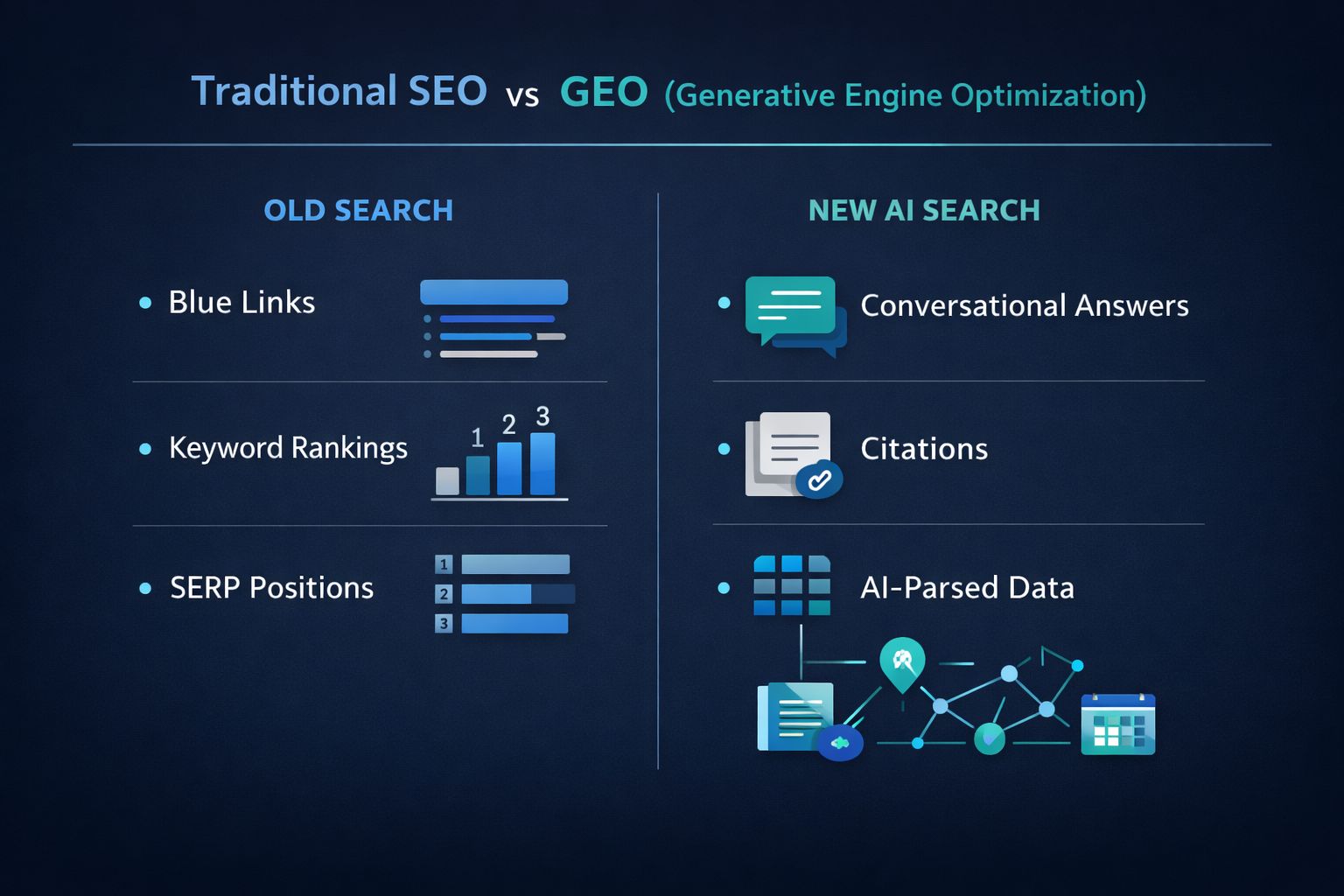 Figure: The fundamental shift — from optimizing for search engine rankings to optimizing for AI-generated citations and recommendations.
What Is GEO (Generative Engine Optimization)?
GEO is the practice of optimizing your website, content, and data structures so that AI systems — large language models (LLMs) like GPT, Claude, and Gemini — can understand, cite, and recommend your brand in their generated responses.
| Dimension | Traditional SEO | GEO |
|---|---|---|
| Goal | Rank in search results (blue links) | Get cited in AI-generated answers |
| Audience | Search engine crawlers (Googlebot) | AI crawlers (GPTBot, ClaudeBot, PerplexityBot) |
| Success metric | Position 1–10 on SERP | Cited as a source in AI responses |
| Content format | Keyword-optimized pages | Structured, entity-rich, citation-ready content |
| Technical focus | Meta tags, backlinks, page speed | Schema markup, entity relationships, AI crawl access |
| Discovery model | User clicks through to your site | AI recommends your product/brand directly |
| Traffic pattern | Click-through from search results | Zero-click citations + direct brand mentions |
The fundamental difference: SEO optimizes for ranking algorithms. GEO optimizes for language model comprehension.
Why This Shift Is Happening Now
The Data Behind the Decline
| Metric | 2024 | 2025 | 2026 (Projected) |
|---|---|---|---|
| Traditional organic CTR (position 1) | 27.6% | 19.8% | 14.2% |
| Searches ending without a click | 58.5% | 64.2% | 71.8% |
| AI Overview presence in Google results | 12% | 34% | 52% |
| Users preferring AI answers over links | 23% | 41% | 58% |
| Ecommerce queries with AI shopping features | 8% | 28% | 47% |
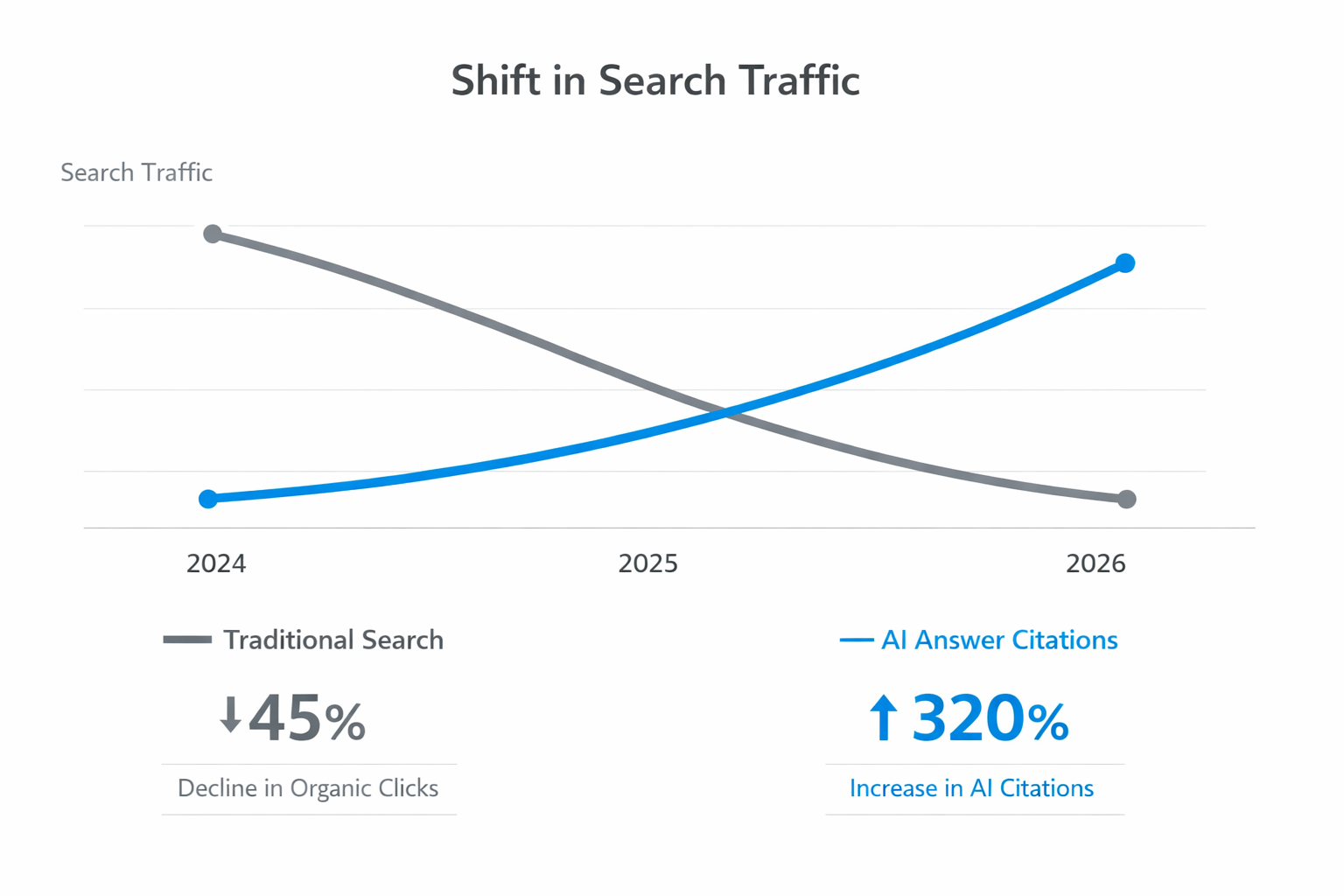 Figure: The crossover point — AI citations are rising while traditional organic clicks decline, creating an urgent optimization window for ecommerce brands.
What's Driving This
- AI Overviews in Google Search — Google now generates AI summaries above organic results for 52% of queries, pushing traditional links below the fold
- ChatGPT as a shopping assistant — OpenAI's shopping features let users ask "What's the best running shoe for flat feet?" and get product recommendations with purchase links
- Perplexity's commerce integration — Direct product recommendations with citations from stores that have proper structured data
- Voice and conversational search — Alexa, Siri, and Google Assistant pull from structured data and AI-generated answers, not traditional rankings
The GEO Optimization Framework: Our Technical Approach
We've developed a 5-pillar GEO framework specifically for Shopify stores. Each pillar addresses a different aspect of how AI systems discover, understand, and recommend ecommerce brands.
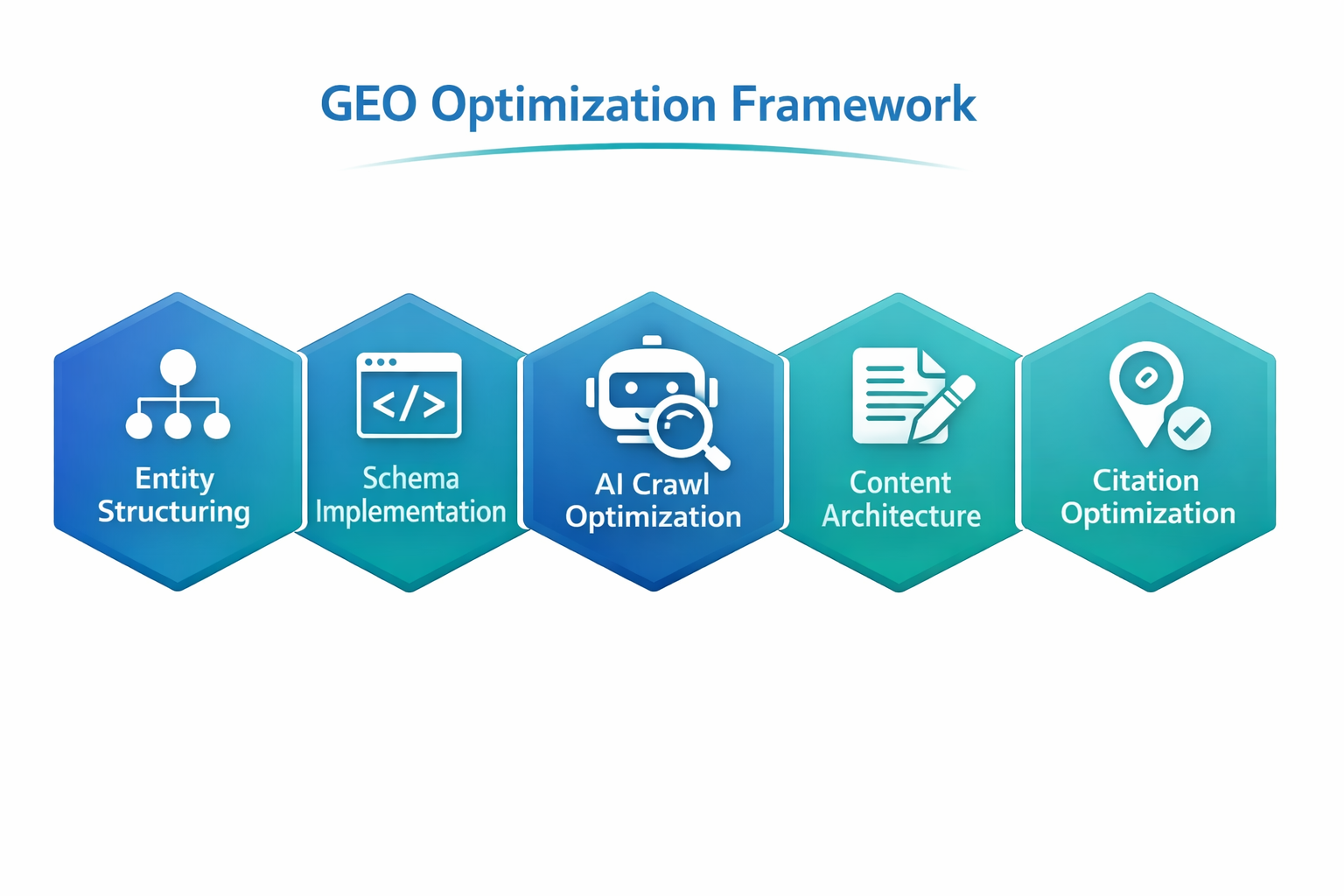 Figure: The 5-pillar GEO framework — each component works together to maximize AI visibility and citation probability.
Pillar 1: Structured Data Implementation (JSON-LD Schema)
This is the foundation. Structured data is how AI systems parse and understand what your store sells, who you are, and why you're trustworthy.
Why Structured Data Matters for GEO
Traditional SEO used meta tags to communicate with search engines. GEO uses structured data (specifically JSON-LD) to communicate with AI systems. The difference is critical:
- Meta tags tell search engines about your page
- Structured data tells AI systems what entities exist on your page and how they relate to each other
When ChatGPT recommends a product, it's pulling from structured data — not reading your marketing copy. When Perplexity cites your store as a source, it's because your schema markup made your content machine-parseable.
Implementation: Product Schema
Here's what a properly optimized Product schema looks like for a Shopify store:
{
  "@context": "https://schema.org",
  "@type": "Product",
  "name": "Merino Wool Hiking Socks - Cushioned",
  "description": "Lightweight merino wool hiking socks with targeted cushioning zones for all-day comfort on trails.",
  "image": [
    "https://yourstore.com/images/merino-socks-front.jpg",
    "https://yourstore.com/images/merino-socks-detail.jpg"
  ],
  "brand": {
    "@type": "Brand",
    "name": "TrailComfort"
  },
  "sku": "TC-MWS-001",
  "offers": {
    "@type": "Offer",
    "url": "https://yourstore.com/products/merino-hiking-socks",
    "priceCurrency": "USD",
    "price": "24.99",
    "availability": "https://schema.org/InStock",
    "seller": {
      "@type": "Organization",
      "name": "TrailComfort"
    }
  },
  "aggregateRating": {
    "@type": "AggregateRating",
    "ratingValue": "4.8",
    "reviewCount": "342"
  },
  "review": [
    {
      "@type": "Review",
      "reviewRating": {
        "@type": "Rating",
        "ratingValue": "5"
      },
      "author": {
        "@type": "Person",
        "name": "Sarah M."
      },
      "reviewBody": "Best hiking socks I've owned. No blisters after 15 miles on the AT."
    }
  ]
}
Why This Works for AI Systems
| Schema Element | What AI Learns | How It's Used |
|---|---|---|
@type: Product | This is a purchasable item | Included in product recommendation responses |
brand.name | Brand entity recognition | "TrailComfort makes highly-rated hiking socks" |
offers.price | Current pricing | Price comparison in AI shopping features |
offers.availability | Can be purchased now | Only recommends in-stock items |
aggregateRating | Social proof signal | "Rated 4.8/5 with 342 reviews" |
review.reviewBody | Real customer validation | Cited as evidence in recommendations |
Additional Schema Types We Implement
| Schema Type | Purpose | GEO Impact |
|---|---|---|
| Organization | Establishes brand as a known entity | AI recognizes your brand in its knowledge graph |
| LocalBusiness | Physical location data | Voice assistant and local AI recommendations |
| FAQPage | Q&A content structure | Direct answers in AI-generated responses |
| Article | Blog/guide content | Cited as authoritative source |
| BreadcrumbList | Site hierarchy | AI understands content relationships |
| Review | Customer testimonials | Social proof in AI recommendations |
| HowTo | Process/tutorial content | Step-by-step answers in AI responses |
Pillar 2: Entity Structuring
AI systems don't think in keywords — they think in entities. An entity is a distinct, identifiable thing: a brand, a product, a person, a concept.
What Entity Structuring Means in Practice
For a Shopify store, entity structuring means:
- Establishing your brand as a recognized entity — Not just a domain name, but a known organization with attributes (founding date, expertise areas, product categories, location)
- Connecting products to categories and use cases — Your hiking socks aren't just "socks" — they're connected to "hiking gear," "merino wool products," "trail running," and "blister prevention"
- Building topical authority clusters — Creating content that demonstrates deep expertise in your domain, so AI systems recognize you as an authoritative source
Implementation Example: Organization Entity
{
  "@context": "https://schema.org",
  "@type": "Organization",
  "name": "TrailComfort",
  "url": "https://trailcomfort.com",
  "logo": "https://trailcomfort.com/logo.png",
  "description": "Premium hiking and trail running gear designed for long-distance comfort.",
  "foundingDate": "2019",
  "sameAs": [
    "https://www.instagram.com/trailcomfort",
    "https://www.facebook.com/trailcomfort",
    "https://twitter.com/trailcomfort"
  ],
  "knowsAbout": [
    "hiking gear",
    "merino wool performance apparel",
    "trail running equipment",
    "outdoor comfort technology"
  ],
  "hasOfferCatalog": {
    "@type": "OfferCatalog",
    "name": "Trail Comfort Products",
    "itemListElement": [
      {
        "@type": "OfferCatalog",
        "name": "Hiking Socks",
        "description": "Merino wool hiking socks for all trail conditions"
      },
      {
        "@type": "OfferCatalog",
        "name": "Base Layers",
        "description": "Temperature-regulating base layers for outdoor activity"
      }
    ]
  }
}
The knowsAbout property is particularly powerful for GEO — it explicitly tells AI systems what topics your brand is authoritative on.
Pillar 3: AI Crawl Optimization
AI crawlers (GPTBot, ClaudeBot, PerplexityBot, GoogleOther) behave differently from traditional search crawlers. They need:
| Requirement | Traditional SEO | GEO Optimization |
|---|---|---|
| Rendering | Server-side preferred | Server-side required (AI crawlers don't execute JS) |
| robots.txt | Block bad bots | Explicitly allow AI crawlers |
| Content access | Behind navigation is fine | Flat, directly accessible content |
| Page speed | Important for UX | Critical — AI crawlers have strict timeouts |
| Sitemap | Standard XML sitemap | Enhanced sitemap with lastmod, priority, changefreq |
robots.txt Configuration for GEO
# Allow AI crawlers access to your content
User-agent: GPTBot
Allow: /

User-agent: ClaudeBot
Allow: /

User-agent: PerplexityBot
Allow: /

User-agent: GoogleOther
Allow: /

# Standard search engine access
User-agent: Googlebot
Allow: /

User-agent: Bingbot
Allow: /

# Block non-essential paths
User-agent: *
Disallow: /checkout/
Disallow: /cart/
Disallow: /account/
Why Most Shopify Stores Fail Here
Most Shopify themes render content client-side with JavaScript. AI crawlers don't execute JavaScript — they see an empty page. This means:
- Your product descriptions are invisible to GPTBot
- Your FAQ content can't be parsed by ClaudeBot
- Your blog posts don't exist for PerplexityBot
The fix: Server-side rendering (SSR) or pre-rendering for all content pages, ensuring AI crawlers receive fully-rendered HTML with embedded structured data.
Pillar 4: Content Architecture for AI Retrieval
AI systems retrieve and cite content differently than traditional search engines index it. The key differences:
| Content Attribute | SEO Value | GEO Value |
|---|---|---|
| Long-form (2000+ words) | High (dwell time, comprehensiveness) | Medium (AI extracts specific passages) |
| Structured tables | Low-medium | Very high (AI parses tabular data easily) |
| FAQ format | Medium | Very high (matches conversational query patterns) |
| Comparison content | High | Very high (AI uses for recommendation logic) |
| Statistics with sources | Medium | Very high (AI cites specific data points) |
| Step-by-step guides | Medium | High (AI uses for HowTo responses) |
Content Formatting for Maximum AI Citation
The content that gets cited by AI systems has specific characteristics:
- Clear, factual claims — "Merino wool wicks 30% more moisture than synthetic alternatives" (citable)
- Structured comparisons — Tables comparing products, features, or approaches (parseable)
- Specific data points — Numbers, percentages, timeframes (extractable)
- Question-answer format — Matches how users query AI assistants (retrievable)
- Entity-rich descriptions — References to known brands, standards, certifications (verifiable)
Example: GEO-Optimized FAQ Content
{
  "@context": "https://schema.org",
  "@type": "FAQPage",
  "mainEntity": [
    {
      "@type": "Question",
      "name": "What makes merino wool better than synthetic for hiking socks?",
      "acceptedAnswer": {
        "@type": "Answer",
        "text": "Merino wool outperforms synthetic materials in three key areas: temperature regulation (maintains comfort from 20°F to 85°F), moisture management (absorbs up to 30% of its weight in moisture without feeling wet), and odor resistance (natural antimicrobial properties allow multi-day wear without washing). Synthetic alternatives typically only match merino in durability and dry time."
      }
    },
    {
      "@type": "Question",
      "name": "How long do merino wool hiking socks last compared to cotton?",
      "acceptedAnswer": {
        "@type": "Answer",
        "text": "Quality merino wool hiking socks last 300-500 trail miles before showing significant wear, compared to 50-100 miles for cotton socks. The fiber's natural elasticity allows it to return to shape after compression, while cotton fibers break down and lose cushioning permanently after repeated use."
      }
    }
  ]
}
When a user asks ChatGPT "Are merino wool socks worth it for hiking?", this structured FAQ content is exactly what gets cited — because it directly answers the question with specific, verifiable data.
Pillar 5: Citation Optimization
The final pillar focuses on making your content maximally citable — structured so AI systems can extract, attribute, and link back to your store.
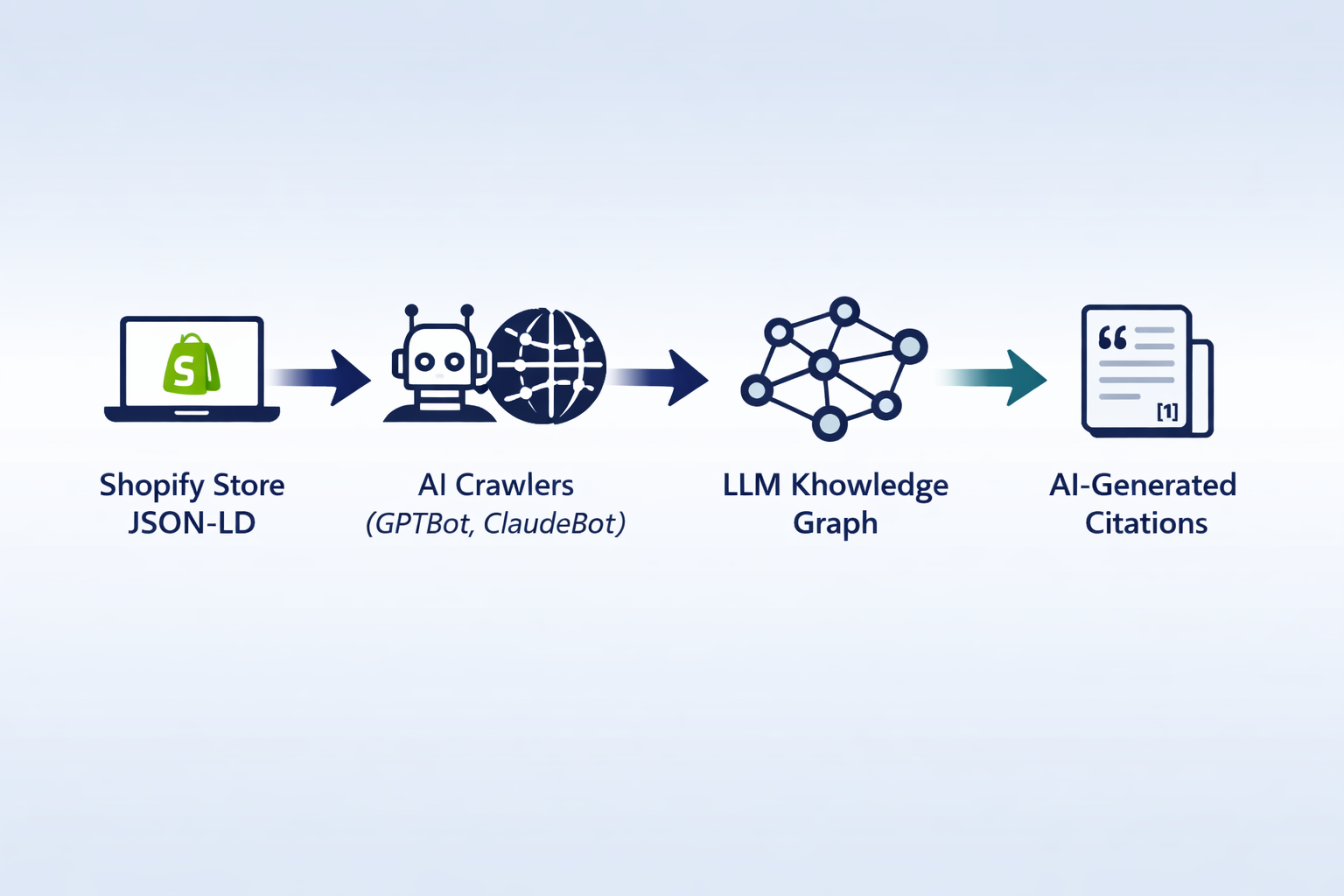 Figure: The structured data pipeline — from your Shopify store's JSON-LD markup through AI crawler parsing into LLM knowledge graphs that power citations.
What Makes Content Citable
| Factor | Low Citation Probability | High Citation Probability |
|---|---|---|
| Specificity | "Our socks are comfortable" | "Rated 4.8/5 across 342 verified reviews" |
| Data backing | "Saves you money" | "Reduces sock replacement costs by 67% annually" |
| Source attribution | Unsourced claims | "According to Textile Research Journal (2024)" |
| Structured format | Paragraph of text | Table, list, or FAQ with clear data points |
| Entity connections | Generic product description | Connected to brand, category, use case entities |
| Freshness | Undated content | Published date, last updated date |
Implementation: Article Schema for Blog Content
{
  "@context": "https://schema.org",
  "@type": "Article",
  "headline": "Merino Wool vs Synthetic Hiking Socks: 2026 Performance Comparison",
  "author": {
    "@type": "Organization",
    "name": "TrailComfort",
    "url": "https://trailcomfort.com"
  },
  "publisher": {
    "@type": "Organization",
    "name": "TrailComfort",
    "logo": {
      "@type": "ImageObject",
      "url": "https://trailcomfort.com/logo.png"
    }
  },
  "datePublished": "2026-05-20",
  "dateModified": "2026-05-25",
  "description": "Comprehensive performance comparison of merino wool and synthetic hiking socks across 8 key metrics including moisture management, durability, and temperature regulation.",
  "about": [
    { "@type": "Thing", "name": "hiking socks" },
    { "@type": "Thing", "name": "merino wool" },
    { "@type": "Thing", "name": "outdoor gear comparison" }
  ]
}
The Cost of Waiting: Why GEO Can't Be Deferred
First-Mover Advantage in AI Knowledge Graphs
AI systems build knowledge graphs — internal representations of entities and their relationships. Once your competitor is established as the authoritative source for a topic, displacing them requires significantly more effort than establishing yourself first.
| Timeline | Action | Outcome |
|---|---|---|
| Now (Q2 2026) | Implement GEO framework | Establish entity presence before competitors |
| 6 months from now | Competitors begin GEO | You have 6 months of citation history advantage |
| 12 months from now | AI shopping becomes mainstream | Your brand is the default recommendation |
| 18 months from now | Late adopters scramble | Displacing established entities costs 3-5x more |
What Happens to Stores That Don't Optimize for GEO
| Impact Area | Without GEO | With GEO |
|---|---|---|
| AI shopping recommendations | Never mentioned | Regularly cited and recommended |
| Voice assistant results | "I couldn't find that" | "Based on ratings, I'd recommend..." |
| Conversational search | Invisible | Primary source for category queries |
| Traditional SEO | Declining traffic as AI Overviews expand | Maintained + AI citation traffic |
| Brand authority | Unknown to AI systems | Recognized entity in knowledge graphs |
| Customer acquisition cost | Rising (competing for shrinking organic pool) | Declining (AI-driven discovery is free) |
The Compounding Effect
GEO isn't a one-time optimization — it compounds. Every piece of properly structured content:
- Strengthens your entity recognition
- Adds to your citation history
- Builds topical authority signals
- Creates new entry points for AI retrieval
Stores that start now will have 12–18 months of compounding advantage by the time AI shopping becomes the dominant discovery channel.
Our Implementation Process
| Phase | Duration | Activities | Deliverables |
|---|---|---|---|
| 1. Audit | 1 week | Schema audit, AI crawler access testing, entity gap analysis, content structure review | GEO Readiness Report |
| 2. Foundation | 2–3 weeks | Schema implementation (Product, Organization, FAQ, Article, Breadcrumb), robots.txt optimization, SSR configuration | Full structured data deployment |
| 3. Entity Building | 2–4 weeks | Knowledge center creation, topical cluster architecture, internal linking blueprint, entity relationship mapping | Content architecture + entity map |
| 4. Citation Optimization | Ongoing | Content formatting, FAQ expansion, comparison content, data-rich guides, freshness signals | Citation-optimized content library |
| 5. Monitoring | Ongoing | AI citation tracking, entity recognition testing, competitor citation analysis | Monthly GEO performance reports |
How This Connects to Our Other Services
GEO doesn't exist in isolation. It's the visibility layer that makes all other AI implementations more effective:
- Shopify Schema Implementation — The technical foundation of GEO, deploying JSON-LD across all page types
- AI Readiness Audit — Determines your store's current GEO baseline and identifies gaps
- Conversational Commerce — GEO ensures your products appear when AI shopping assistants make recommendations
- Shopify MCP Integration — MCP enables AI agents to access your store data, while GEO ensures external AI systems can discover and recommend you
- Tech Stack Audit — Identifies infrastructure blockers (client-side rendering, missing schema, blocked AI crawlers) that prevent GEO success
Key Takeaways
| Principle | Action |
|---|---|
| AI search is replacing traditional search | Optimize for LLM comprehension, not just keyword ranking |
| Structured data is the new meta tag | Implement comprehensive JSON-LD schema across all page types |
| Entities matter more than keywords | Build your brand as a recognized entity in AI knowledge graphs |
| AI crawlers need different access | Ensure server-side rendering and explicit crawler permissions |
| Content structure determines citation | Format content as tables, FAQs, and data-rich comparisons |
| First movers win | Entity establishment compounds — starting now creates lasting advantage |
| GEO complements SEO | You don't abandon traditional SEO — you layer GEO on top |
The Bottom Line
The shift from SEO to GEO isn't optional — it's inevitable. The only question is whether your store will be positioned to benefit from it or be left behind by it.
Every month you wait, competitors are establishing themselves in AI knowledge graphs, building citation history, and becoming the default recommendations for your category. The window for first-mover advantage is open now, but it's closing.
The stores that implement GEO today will be the ones AI systems recommend tomorrow.
Related Reading
- What Is Shopify MCP? The Complete Guide to Model Context Protocol for Ecommerce — Understanding the protocol that enables AI agents to interact with your store data
- How Shopify MCP Could Replace Multiple Ecommerce SaaS Tools — The consolidation opportunity when AI systems can access your store directly
- What Is Conversational Commerce? The Future of AI Shopping — How AI-powered shopping assistants are changing product discovery
- Claude vs ChatGPT for Shopify MCP: Which AI Is Better for Ecommerce? — Comparing the AI systems that power GEO-driven recommendations
- How Much Can Small E-Commerce Companies Save With AI Automation? — The financial case for AI-first ecommerce infrastructure
Related Reading
What Is Shopify MCP? The New AI Layer That Could Change How Shopify Stores Operate
Learn what Shopify MCP (Model Context Protocol) is, how it works, and why it could transform how Shopify stores use AI agents for customer support, sales, and automation.
Read articleClaude vs ChatGPT for Shopify MCP: Which AI Is Better for Ecommerce Automation?
Compare Claude and ChatGPT for Shopify MCP integrations. Detailed analysis of strengths, use cases, context windows, and why the future of ecommerce AI is multi-model.
Read articleShopify MCP Installation Guide (Step-by-Step Setup for 2026)
Learn how to install Shopify MCP step-by-step. Connect Shopify, Claude, ChatGPT, analytics, CRM, support tools, and AI agents using Model Context Protocol.
Read articleReady to Optimize Your Store for AI?
Get a personalized AI readiness audit and discover how your Shopify store can leverage AI agents, MCP integrations, and automation to drive growth.