How AI Shopping Agents Discover Shopify Products (And What Store Owners Must Do to Get Found)
The New Era of Ecommerce Discovery
For more than two decades, ecommerce growth depended heavily on traditional search engines. Merchants optimized product pages for Google, invested in paid advertising, and competed for rankings on search results pages.
That model is rapidly changing.
Today, consumers are increasingly using AI-powered shopping assistants such as ChatGPT, Claude, Perplexity, Gemini, and emerging commerce-focused AI agents to research products, compare brands, answer purchase questions, and even complete transactions.
Rather than typing:
"best wine rack for a small apartment"
A shopper may now ask:
"What's the best wall-mounted wine rack for a small apartment under $500?"
The AI agent then analyzes information from multiple sources and recommends products directly.
For Shopify merchants, this raises a critical question:
How do AI shopping agents discover products in the first place?
Understanding this process is becoming one of the most important competitive advantages in ecommerce — and it's closely tied to how AI platforms choose which brands to mention.
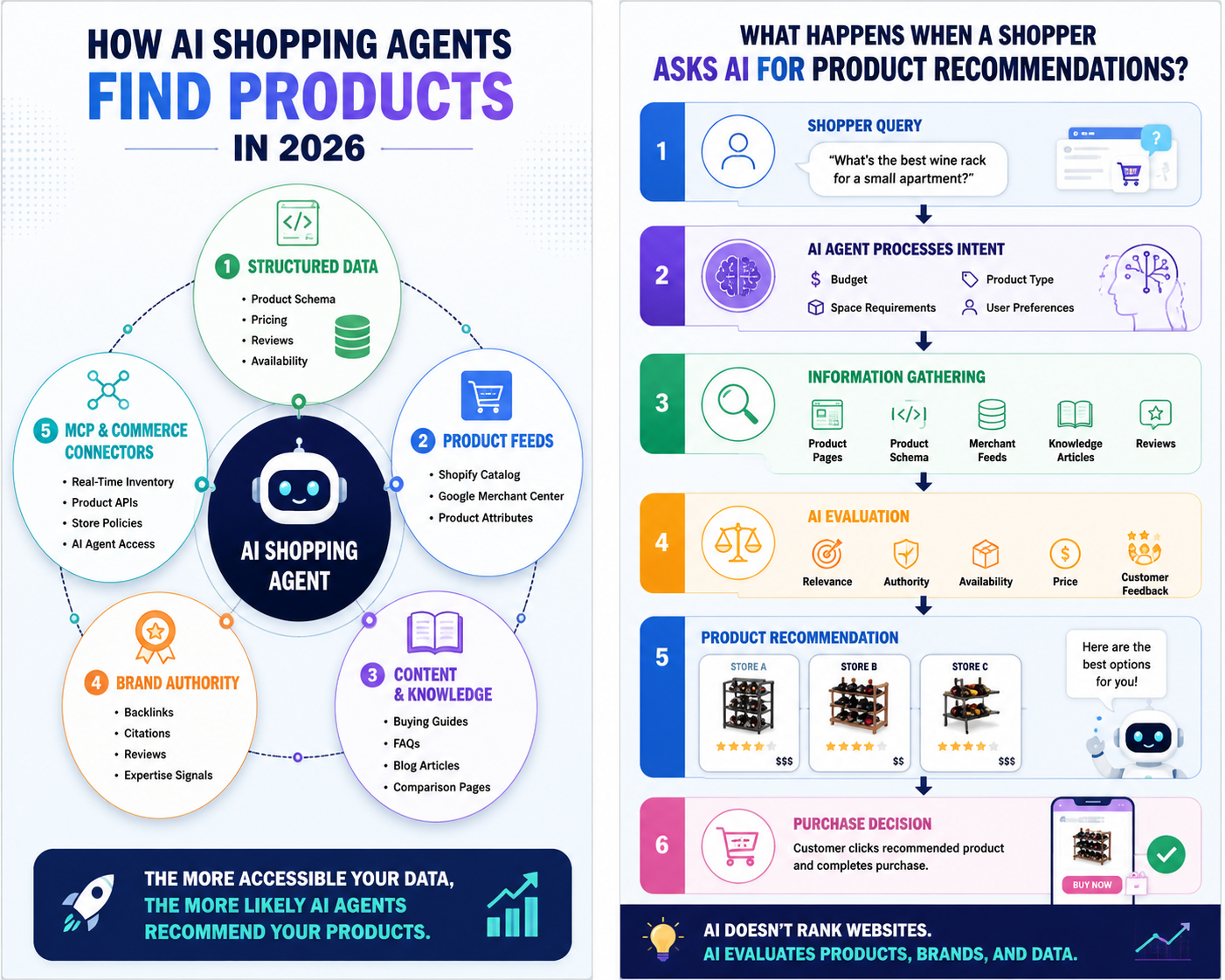
How AI Shopping Agents Actually Find Products
Unlike traditional search engines that primarily crawl and rank web pages, AI shopping agents gather information from multiple sources simultaneously.
AI Agent Data Sources
| Source Type | What It Provides | Discovery Impact |
|---|---|---|
| Website content | Product descriptions, brand messaging | High — primary content understanding |
| Product feeds | Machine-readable catalog data | Very High — structured product information |
| Structured data | Schema markup, JSON-LD | Very High — reliable attribute extraction |
| Merchant APIs | Real-time inventory, pricing | High — accurate availability data |
| Product catalogs | Full catalog access | High — comprehensive product coverage |
| Customer reviews | Sentiment, quality signals | Medium — trust and authority signals |
| Knowledge bases | Educational content, FAQs | Medium — contextual understanding |
| Marketplace data | Competitive pricing, alternatives | Medium — comparison context |
| Brand authority signals | Expertise, reputation | High — recommendation confidence |
| Commerce connectors (MCP) | Direct system access | Very High — real-time, accurate data |
The result is a much more sophisticated product discovery process.
What AI Agents Evaluate
| Evaluation Criteria | Traditional Search | AI Shopping Agent |
|---|---|---|
| Product relevance | Keyword matching | Semantic understanding |
| Product attributes | Page content parsing | Structured data extraction |
| Merchant trustworthiness | Domain authority | Multi-signal authority assessment |
| Inventory availability | Not typically checked | Real-time verification |
| Product specifications | Manual comparison | Automated attribute comparison |
| Customer sentiment | Review snippets | Aggregated sentiment analysis |
| Price competitiveness | Not directly ranked | Active price comparison |
| Shipping details | Rarely factored | Included in recommendations |
This means the store with the best content and most accessible data may receive recommendations even if it isn't ranking #1 on Google.
The Five Ways AI Shopping Agents Discover Shopify Products
1. Structured Product Data
Structured data is one of the most important signals for AI discovery.
When product information is properly organized using schema markup, AI systems can quickly understand:
| Data Element | Without Structured Data | With Structured Data |
|---|---|---|
| Product name | Inferred from page title | Explicitly defined |
| Brand | Guessed from context | Clearly attributed |
| Price | Extracted from text | Machine-readable value |
| Availability | Unknown | Real-time status |
| SKU | Not accessible | Directly referenced |
| Images | Generic page images | Product-specific media |
| Reviews | Unstructured text | Rated and aggregated |
| Descriptions | Full page content | Targeted product copy |
Without structured data, AI systems often need to guess or infer information.
With structured data, product understanding becomes much more reliable.
Example
Instead of reading:
"Premium metal wine rack available now."
An AI system sees:
| Attribute | Value |
|---|---|
| Product Type | Wine Rack |
| Material | Steel |
| Capacity | 18 Bottles |
| Availability | In Stock |
| Price | $299 |
This dramatically improves discoverability. For a complete implementation guide, see How to Optimize Your Shopify Store for AI Search (GEO).
2. Product Feed Integration
Many AI shopping platforms rely heavily on product feeds.
| Feed Type | Platform | AI Agent Access |
|---|---|---|
| Google Merchant Center | Google Shopping, Gemini | Direct product data |
| Shopify product feeds | Multiple AI platforms | Catalog information |
| Catalog exports | Custom AI agents | Bulk product data |
| Commerce APIs | Advanced integrations | Real-time queries |
Product feeds provide machine-readable information that AI agents can evaluate instantly.
| Feed Quality | AI Discovery Impact |
|---|---|
| Complete, accurate, current | High visibility and accurate recommendations |
| Missing attributes | Reduced recommendation confidence |
| Outdated pricing/availability | Incorrect or excluded recommendations |
| No feed present | Significantly reduced AI visibility |
If product feeds are inaccurate, incomplete, or outdated, AI recommendations suffer.
Merchants with optimized feeds often gain a major visibility advantage.
3. Website Content and Knowledge Centers
AI agents increasingly use informational content to understand products and brands.
| Content Type | AI Discovery Value | Example |
|---|---|---|
| Buying guides | Very High | "How to Choose the Right Wine Rack" |
| Product comparisons | High | "Wall-Mounted vs Floor-Standing Wine Racks" |
| FAQ pages | High | Common customer questions answered |
| Installation guides | Medium | Setup and usage instructions |
| Knowledge centers | Very High | Comprehensive resource libraries |
| Industry resources | Medium | Trend analysis and expert insights |
For example, a customer asks:
"What's the difference between wall-mounted wine racks and floor-standing wine racks?"
An AI agent may pull information from an educational article before recommending products.
This is why content marketing is becoming even more valuable in the AI era — and why the shift from SEO to GEO is accelerating.
The brands that educate consumers often become the brands that get recommended.
4. Brand Authority Signals
AI systems evaluate authority similarly to how humans do.
| Authority Signal | What AI Evaluates | How to Build It |
|---|---|---|
| Industry expertise | Depth and accuracy of content | Publish expert-level guides |
| Educational content | Helpfulness and comprehensiveness | Create buying guides and tutorials |
| Consistent publishing | Regular content updates | Maintain a content calendar |
| Customer reviews | Volume, recency, sentiment | Encourage authentic reviews |
| Third-party mentions | Citations from other sources | Build industry relationships |
| Backlinks | Quality and relevance of linking sites | Create linkable resources |
| Citations | References in authoritative content | Contribute to industry publications |
| Business reputation | Overall brand perception | Deliver excellent customer experiences |
When multiple merchants sell similar products, authority often becomes the deciding factor.
This is why brands investing in thought leadership and expertise are increasingly appearing in AI-generated recommendations. Understanding how ChatGPT, Gemini & Perplexity choose which brands to mention is critical for building these signals effectively.
5. Commerce Connectors and MCP Servers
One of the newest developments in AI commerce is the adoption of Model Context Protocol (MCP).
MCP allows AI systems to securely connect to external data sources and commerce platforms.
| MCP Capability | What It Enables | Business Impact |
|---|---|---|
| Product catalogs | AI accesses full product database | Complete product visibility |
| Inventory levels | Real-time stock information | Accurate availability recommendations |
| Pricing data | Current pricing and promotions | Competitive price comparisons |
| Store policies | Shipping, returns, warranties | Complete purchase context |
| Order information | Transaction history | Personalized recommendations |
| Customer support knowledge | FAQ and policy access | Automated customer assistance |
Instead of relying solely on crawled content, AI agents can retrieve information directly from connected systems.
This creates a more accurate and real-time shopping experience.
As MCP adoption grows, properly configured Shopify MCP implementations may become a major discovery channel for ecommerce businesses. For installation guidance, see our Shopify MCP Installation Guide.
Why Traditional SEO Alone Is No Longer Enough
Traditional SEO remains important.
However, ranking well in Google does not automatically mean AI agents will recommend your products.
| Traditional SEO | AI Commerce Optimization |
|---|---|
| Keyword rankings | Product understanding |
| Backlinks | Structured data |
| Search traffic | AI accessibility |
| Page authority | Knowledge authority |
| SERP visibility | Agent recommendations |
| Meta descriptions | Machine-readable attributes |
| Title tags | Semantic product context |
| Internal linking | Knowledge graph connections |
Successful Shopify brands increasingly optimize for both.
This approach is often referred to as:
| Strategy | Focus | Channel |
|---|---|---|
| SEO (Search Engine Optimization) | Traditional search rankings | Google, Bing |
| AEO (Answer Engine Optimization) | Featured snippets, direct answers | Voice assistants, answer boxes |
| GEO (Generative Engine Optimization) | AI agent recommendations | ChatGPT, Claude, Perplexity, Gemini |
Together, these strategies help products appear across both traditional and AI-powered discovery channels. For a comprehensive breakdown of all three, see SEO vs AEO vs GEO: What Ecommerce Brands Need to Know.
How Shopify Merchants Can Improve AI Product Visibility
Create Detailed Product Pages
| Element | Why It Matters | AI Impact |
|---|---|---|
| Comprehensive descriptions | Provides semantic context | High — enables accurate product matching |
| Product specifications | Machine-readable attributes | Very High — structured comparison data |
| Dimensions | Physical product understanding | Medium — filters and compatibility |
| Materials | Quality and category signals | Medium — preference matching |
| FAQs | Answers common questions | High — direct answer sourcing |
| Use cases | Context for recommendations | High — intent matching |
The more context available, the easier it is for AI systems to understand products.
Implement Product Schema
Every product page should contain structured data.
| Schema Type | Purpose | Priority |
|---|---|---|
| Product | Core product information | Essential |
| Offer | Pricing and availability | Essential |
| Review | Customer ratings and feedback | High |
| FAQ | Common questions and answers | High |
| Breadcrumb | Site navigation context | Medium |
| Brand | Manufacturer information | Medium |
Structured data dramatically improves machine readability and is one of the foundations of optimizing your Shopify store for AI search.
Build Topic Authority
Create supporting content around your products.
| Content Type | Example | Authority Signal |
|---|---|---|
| Buying guides | "How to Choose the Right [Product]" | Expertise demonstration |
| Installation instructions | "Setup Guide for [Product]" | Helpfulness and depth |
| Comparison articles | "[Product A] vs [Product B]" | Balanced expertise |
| Industry trends | "2026 Trends in [Category]" | Thought leadership |
| FAQs | Common customer questions | Comprehensive knowledge |
Authority content helps AI agents connect your products to customer questions.
Maintain Accurate Product Feeds
| Feed Element | Requirement | Impact of Inaccuracy |
|---|---|---|
| Current pricing | Updated within hours of changes | Wrong price = lost trust |
| Availability | Real-time stock status | Out-of-stock recommendations damage brand |
| Images | High-quality, multiple angles | Poor images reduce recommendation confidence |
| Product categories | Accurate taxonomy | Miscategorization = missed discovery |
| Descriptions | Complete, keyword-rich | Incomplete data = reduced visibility |
Feed quality directly impacts discoverability.
Prepare for AI Commerce Integrations
Forward-thinking Shopify merchants are beginning to explore:
| Technology | Current Status | Future Impact |
|---|---|---|
| Shopify MCP | Early adoption phase | High — direct AI agent access |
| AI shopping assistants | Growing rapidly | Very High — primary discovery channel |
| Product APIs | Established | High — programmatic access |
| Commerce connectors | Emerging | High — multi-platform visibility |
Stores that prepare early may gain a significant competitive advantage as AI-driven shopping continues to grow. For a detailed look at which connectors matter most, see Shopify MCP Required Connectors Explained.
The Future of Shopify Product Discovery
The next generation of ecommerce will likely involve fewer traditional searches and more conversations with AI assistants.
| Traditional Shopping Journey | AI-Assisted Shopping Journey |
|---|---|
| Search keywords | Ask natural language questions |
| Browse multiple pages | Receive curated recommendations |
| Compare manually | AI compares automatically |
| Read reviews individually | AI summarizes sentiment |
| Complete purchase on site | AI facilitates transaction |
Consumers will increasingly ask:
- "What's the best option?"
- "Compare these products."
- "Which product fits my needs?"
- "Order the best one for me."
The brands that provide accessible, structured, trustworthy information will be the brands that AI systems recommend.
For Shopify merchants, the opportunity is enormous.
Optimizing for AI discovery today may be as important as optimizing for Google was twenty years ago. This is the foundation of conversational commerce — where AI handles the entire shopping experience naturally.
Final Thoughts
AI shopping agents are transforming how consumers discover products online.
Instead of relying solely on search rankings, merchants must ensure their products are accessible through structured data, product feeds, authoritative content, and emerging AI commerce technologies such as Shopify MCP.
The stores that embrace AI commerce optimization today will be better positioned to earn recommendations, visibility, and sales tomorrow.
As AI-powered shopping becomes mainstream, discoverability will increasingly depend on how effectively your Shopify store communicates with both humans and machines.
How Shopify Agent AI Helps
Optimizing for AI product discovery requires a multi-layered approach.
| Service Area | What's Involved |
|---|---|
| Structured data implementation | Product schema, JSON-LD, rich snippets |
| Product feed optimization | Feed accuracy, completeness, freshness |
| Content strategy | Authority-building content for AI discovery |
| MCP implementation | Shopify MCP server setup and connector configuration |
| GEO optimization | AI search visibility across platforms |
| AI readiness assessment | Evaluating current AI discoverability |
At Shopify Agent AI, we help ecommerce businesses build AI-discoverable stores that earn recommendations from ChatGPT, Claude, Gemini, Perplexity, and future AI shopping agents.
Whether you're implementing structured data, optimizing product feeds, building authority content, or deploying Shopify MCP, the goal remains the same:
Make your products the ones AI agents recommend.
Related Reading
How ChatGPT, Gemini & Perplexity Choose Which Brands to Mention — Understanding AI brand visibility and recommendation algorithms.
How to Optimize Your Shopify Store for AI Search (GEO) — Step-by-step implementation guide for AI search visibility.
Shopify MCP Server Explained: What It Is, How It Works, and Which Connectors You Need — Technical overview of MCP server architecture and implementation patterns.
SEO vs AEO vs GEO: What Ecommerce Brands Need to Know — Understanding the three-layer search evolution framework.
What Is Conversational Commerce? The Future of AI Shopping — How AI is transforming the entire shopping experience.
The Shift from SEO to GEO: Generative Engine Optimization — Why traditional SEO alone is no longer sufficient for ecommerce visibility.
Shopify MCP Required Connectors Explained (2026 Guide) — Which connectors are essential for AI agent workflows.
Shopify MCP Installation Guide (Step-by-Step Setup for 2026) — Complete guide to installing and configuring Shopify MCP.
Related Reading
What Is Shopify MCP? The New AI Layer That Could Change How Shopify Stores Operate
Learn what Shopify MCP (Model Context Protocol) is, how it works, and why it could transform how Shopify stores use AI agents for customer support, sales, and automation.
Read articleThe Shift from SEO to GEO: Why Generative Engine Optimization Is the Future of Ecommerce Visibility
Traditional SEO is losing ground to AI-powered search. Learn how Generative Engine Optimization (GEO) works, the technical implementation details including structured data and entity structuring, and why Shopify stores that don't adapt will become invisible.
Read articleClaude vs ChatGPT for Shopify MCP: Which AI Is Better for Ecommerce Automation?
Compare Claude and ChatGPT for Shopify MCP integrations. Detailed analysis of strengths, use cases, context windows, and why the future of ecommerce AI is multi-model.
Read articleReady to Optimize Your Store for AI?
Get a personalized AI readiness audit and discover how your Shopify store can leverage AI agents, MCP integrations, and automation to drive growth.